AI Voice Agent
Never miss another call.
Learn more


AI Voice Agent
Never miss another call.


If your phone system vendor cannot answer where the call audio sits, where the SMS metadata sits, and whether the contract guarantees Australian Privacy Principles compliance on cross-border disclosure, your allied health practice is already in the privacy breach zone, and you have not signed the contract yet.
This is for an Australian allied health practice principal or manager evaluating phone systems. The Privacy Act 1988 applies, the Notifiable Data Breaches scheme applies, and the multi-practitioner workflow is specific. This article walks through three vendor tests that filter for the actual failure modes of allied health phone systems. The buyer who runs all three on every shortlist will end up with the right system, and the buyer who skips any of them will end up with a privacy bill they did not budget for.
The Privacy Act 1988 “applies to Australian Government agencies and organisations with an annual turnover of more than $three million, and some other organisations.” Most multi-practitioner allied health clinics cross that threshold. The Act explicitly covers “health and medical research.” Allied health practices are APP entities, with the same obligations as any other health provider.
The test is three questions. First, where is the call audio stored? Most cloud PBX providers store call audio in offshore data centres by default, which puts the practice in the cross-border disclosure zone. Second, where is the SMS metadata stored? That includes who messaged whom and when, which is “personal information” under the Act, and triggers the same disclosure question. Third, can the contract include a written clause that the provider will comply with the Australian Privacy Principles on the buyer’s behalf, including the cross-border disclosure rules?
If the vendor cannot answer all three cleanly, the practice carries the privacy risk. A breach of an Australian Privacy Principle is “an ‘interference with the privacy of an individual’ and can lead to regulatory action and penalties.” That is the regulatory bill the practice pays, and the practice pays it alone.
A four-practitioner clinic has different practitioners on different days, in different rooms, on different leave cycles. The phone system needs to know who is on today and when they take calls. A generic SMB PBX routes to a queue. A multi-practitioner clinic routes to a practitioner on a roster.
The test is four routing rules. First, day-of-week routing, where Monday and Tuesday go to different practitioners based on a defined roster. Second, time-of-day routing, where calls before nine a.m. or after five p.m. go to a shared after-hours queue. Third, overflow routing, where if the on-call practitioner is on a call, the call rolls to the next available practitioner in the same discipline. Fourth, after-hours routing, where a seven p.m. call goes to a specific practitioner on a defined roster, or to a colleague’s mobile, rather than to voicemail.
Most cloud PBX providers can do day-of-week and time-of-day. Few do practitioner-specific overflow and after-hours call routing to a defined roster well. Test the vendor by asking them to walk through your clinic’s actual roster live, on a demo call, before you sign. Cloud PBX for multi-practitioner clinics walks through the operational logic in detail.
An allied health phone system is on the front line of a referral and direct-call-driven business. A missed call at seven p.m. is not just a sales-loss event, it is a clinical-risk event. The patient has a flare-up, a medication question, or a referral follow-up and cannot reach a practitioner. The Notifiable Data Breaches scheme “requires” notification when a breach is “likely to result in serious harm.” An after-hours voicemail that says “leave a message and we will get back to you” is not coverage, it is a liability.
The test is whether the vendor’s after-hours setup fits a four-practitioner allied health practice. The right answer is shared call routing: incoming calls route to a specific practitioner on a defined roster, with a fallback to a colleague or a mobile number when the on-call is unavailable. SIPcity handles this well, and the question is whether the vendor walks the practice through the routing on a demo call. For practices that want a different option, the AI voice agent can take patient details, present a summary and sentiment analysis inside the transcription, and leave the call for review the next morning. For a deeper look at the AI voice agent for regulated practices, see the 2026 buyer’s guide for Australian regulated industries. The allied health workflow is specific, and the test is whether the vendor has configured their product for it, not whether the product exists. After-hours phone coverage for allied health runs through the routing that works in practice.
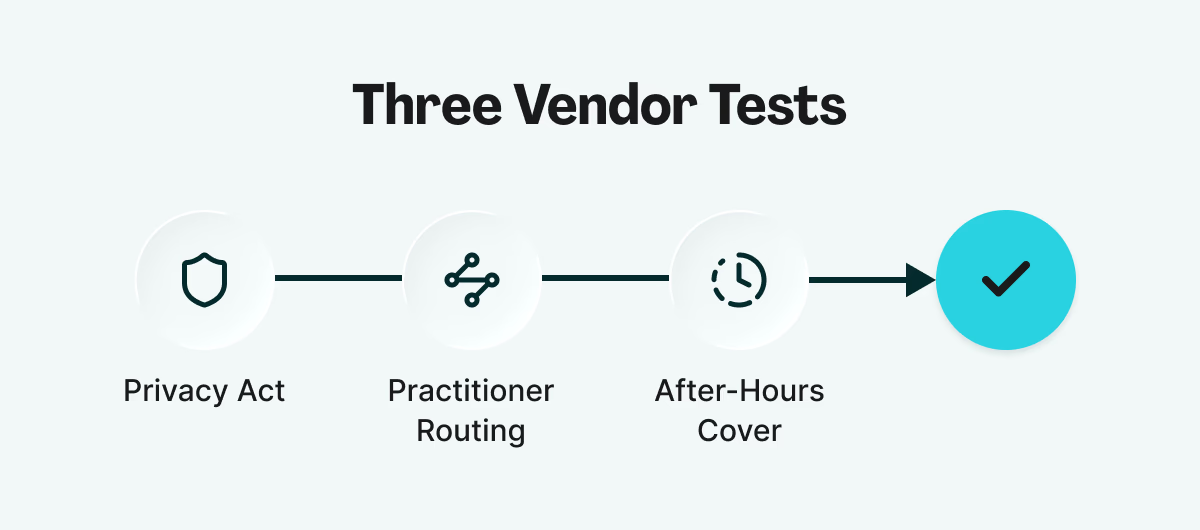
A vendor who passes all three tests has an Australian-hosted cloud phone system for allied health practice, with multi-practitioner routing, after-hours call routing, and a written Australian Privacy Principles compliance clause.
A vendor who does not pass all three is not the right fit. Walk away, even if the price is right. A cheap cloud PBX that puts your practice in cross-border disclosure breach territory is not cheap. It is expensive the moment the OAIC makes a finding.
For the operational picture across the cluster, our allied health phone system page covers the regulatory and workflow framing. This guide is the buyer’s filter. Use it.
Cloud PBX for multi-practitioner clinics walks through the routing, overflow and time-of-day logic a four-to-ten-practitioner practice needs. The AI voice agent guide for Australian regulated industries covers the data sovereignty, latency, and cost questions for financial services, health, and government.
If you are running these three tests on vendors and want a second opinion, we are happy to walk you through what an allied health phone system from SIPcity looks like in practice. We do not run a free trial. We run month-to-month billing with no lock-in, which is how we earn the right to keep your business. Talk to our team and we will pull a shortlist for your practice, in plain English, on a single 30-minute call.