If you deliver supported independent living, the NDIS SIL (Supported Independent Living) registration deadline is closer than it looks. Mandatory registration for SIL and NDIS digital platform providers started on 1 July 2026. You’ve got until 1 October 2026 to apply. Miss that, and you have to stop delivering SIL. This isn’t a proposal still working through Parliament. It’s already in force. Here’s what changed, who it actually catches, and what’s still coming.
- 1 July 2026: mandatory registration starts for SIL and NDIS platform providers.
- 1 October 2026: last day to apply if you’re not yet registered.
- Miss it, and you must stop delivering SIL.
- Maximum penalty for unregistered delivery: two years’ jail, a fine, or both.
- Around 200,000 providers work under the NDIS. Most of them sit outside this rule.
What changed on 1 July 2026
The NDIS Quality and Safeguards Commission now requires supported independent living providers to be registered. Digital platform providers face the same rule. Before this, plenty of providers in these categories operated without ever going through registration. That gap is closing fast.
Deliver SIL on or after 1 July 2026 without registration, and you may be breaching the NDIS Act. The maximum penalty is two years’ imprisonment. Or a fine of 120 penalty units. Or both. That’s a serious consequence for what used to be optional paperwork.
This is the point of the NDIS SIL registration deadline. It moves supported independent living from a category where registration was a choice to one where it’s a legal requirement, backed by criminal penalties. That’s a big shift for a sector that’s had years to get comfortable operating informally.
Who’s actually affected
This is narrower than most NDIS reform coverage makes it sound. The 1 July regime specifically catches SIL providers and NDIS digital platform providers. It doesn’t sweep up every provider in the scheme. There are roughly 200,000 registered and unregistered providers operating under the NDIS. Most of them aren’t touched by this particular deadline.
If you’re not delivering supported independent living, and you’re not running a digital platform connecting participants with support workers, this deadline isn’t the one to lose sleep over. But if you are in scope, the path is clear and time-limited. Unregistered SIL providers must apply for registration by 1 October 2026. There’s no quiet grace period after that date.
What the deadline means in practice
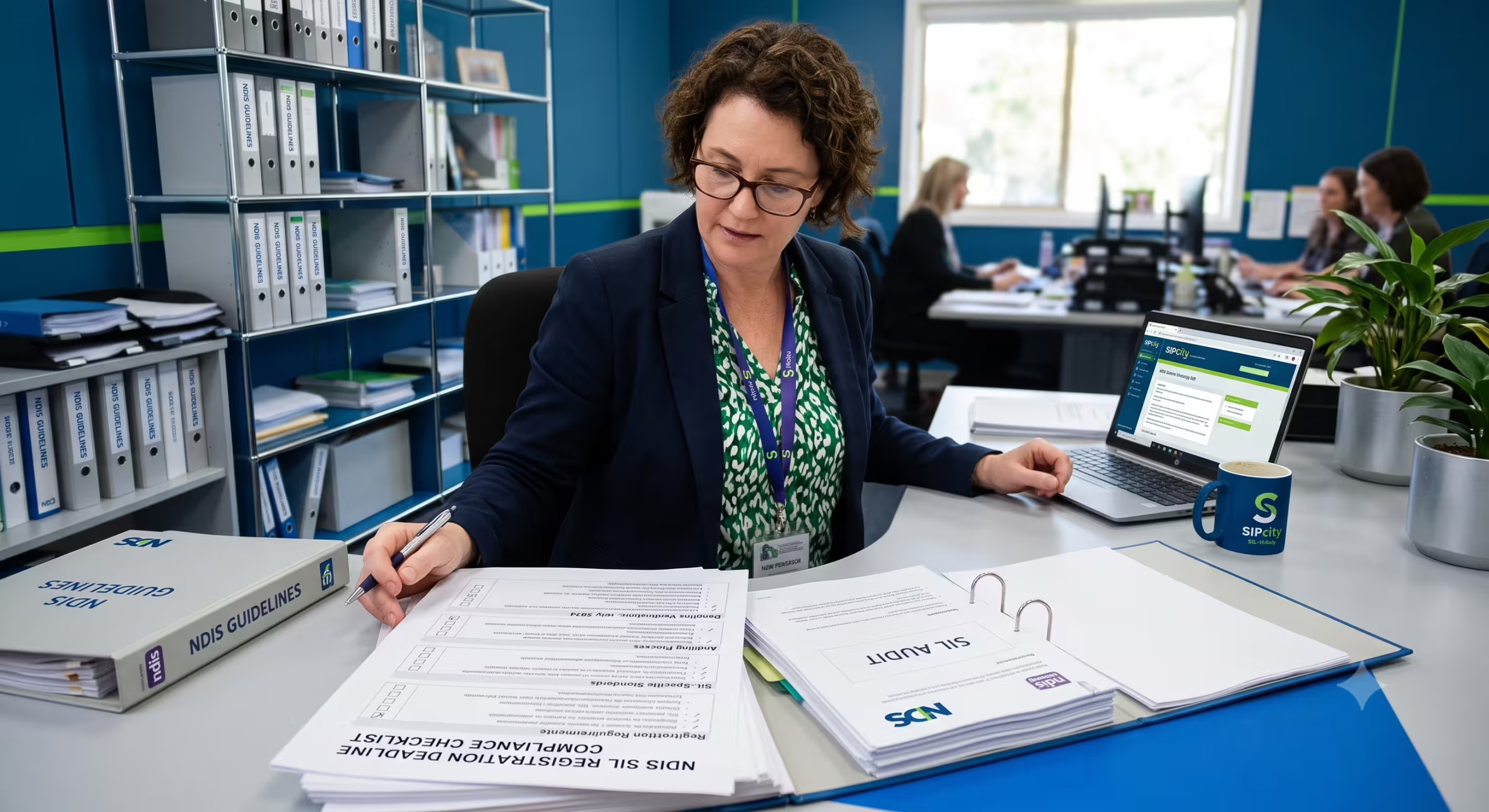
Registration isn’t a form you fill in once and forget. It means demonstrating you meet the NDIS Practice Standards for supported independent living. Then going through an audit to prove it. That process takes time.
Providers who leave their application until September are cutting it fine. Every other unregistered SIL provider in the country is trying to book the same auditors in the same narrow window. Start early, and you get a choice of auditor. Start late, and you take whoever has a slot free.
There’s also a business-sale angle worth knowing. The Department of Health, Disability and Ageing has flagged closer scrutiny of NDIS business sales as mandatory registration expands. The aim is to stop unregistered operators changing hands to dodge the new requirements. If you’re buying or selling an NDIS business right now, registration status isn’t a side detail. It sits at the centre of the deal.
Record keeping: what’s already law, and what’s still a Bill
Here’s a distinction worth getting right, because it’s easy to blur. Providers already have to keep complete, accurate records of the supports they deliver. That’s not new. Support logs, case notes, service agreements, incident reports, rosters, invoices. It’s an existing requirement. The minimum retention period for most of it already runs to seven years, longer again for records involving a child participant. None of that is waiting on Parliament.
What is still a Bill, not a law, is a further piece of legislation moving through Parliament: the NDIS Amendment (Securing the NDIS for Future Generations) Bill 2026. Introduced in May 2026, it has passed its second reading in the House of Representatives. A Senate inquiry is underway, extended until August 2026. It has not passed both Houses. Among its proposals is a seven-year retention duty specifically for records of payment and receipt of NDIS amounts, backed by a civil penalty for providers who don’t comply. That’s an extension of an existing principle into claiming and finance records. It isn’t the invention of record keeping as a concept. Worth watching. Not worth panicking over yet, since it hasn’t commenced and its final form could still change.
What this means for your records right now
The existing rule isn’t about storing every call and text as telecom metadata. The NDIS doesn’t require SIL providers to act as a carrier and log all communications by default. What it does require is that if a call, text or message becomes part of the evidence for an incident, a complaint, or a participant’s case note, that record has to be kept, findable, and attributable, for the same seven years as everything else in that file.
That’s where an ad hoc setup starts to hurt. A support worker leaves. Their personal phone goes with them. If something they said or arranged by text ever needs to be pulled into an incident file or produced for an audit, and it lived on a device the organisation never controlled, you don’t have a record. You have a gap, and gaps are exactly what registration audits are built to find.
This is the practical side of the NDIS SIL registration deadline that gets less attention than the legal side. Registration proves you meet the standard on paper. Being able to produce the right record, from the right conversation, when an auditor or the Commission asks for it, proves you meet it in practice.
For a deeper breakdown of what NDIS record keeping actually requires and how communication workflows support it, the practical guide covers audit trails, personal phone risk, and the systems that hold up under scrutiny.
We’ve written before about what audit-ready communications look like for NDIS providers, and why personal phones create record-keeping problems long before any new law forces the issue. Worth a read if the registration deadline has you looking hard at your processes for the first time. And if AI voice agents handling after-hours participant calls sounds relevant to your service, that’s worth a look too.
Getting ready before the deadline hits
Start earlier than you think you need to. Book your audit slot now, not in September. Separate personal and professional communications if you haven’t already. Participant safety and your own liability both depend on it.
Keep an eye on the Bill’s progress through the Senate too. Its record-keeping proposals aren’t law yet. But providers who get ahead of the direction of travel won’t be scrambling if and when it passes. The NDIS SIL registration deadline is the immediate priority. The reform behind it is the one to watch next.
None of this needs to be a scramble. Providers who treat 1 October as a real deadline, not a soft one, will be through the audit and back to focusing on participants well before it hits. Providers who wait will be competing for the same auditors, the same time slots, and the same window to fix any gaps an audit turns up. Early is easy. Late is expensive.
If you’re an SIL provider trying to get your systems audit-ready before the deadline hits, talk to SIPcity about what a properly documented communications setup looks like.
For the full picture of how SIPcity maps phone, SMS and records to the NDIS Practice Standards and the 1 July 2026 changes, see our NDIS provider phone system page.
Related reading