AI Voice Agent
Never miss another call.
Learn more


AI Voice Agent
Never miss another call.


An after-hours answering service is not after-hours coverage. It is a message-taking service. It turns a clinical-risk event into a voicemail. Then the practice pays the clinical and privacy costs the next morning.
So this is the third test in the allied health buyer’s guide, focused on after-hours phone coverage for allied health. The phone system for allied health practice guide covers the Privacy Act 1988 cross-border test and the multi-practitioner routing test. The allied health phone system page covers the rules. In this article, we cover the after-hours workflow. The one decision that decides if a call reaches a real practitioner. Or if it dies in a stranger’s voicemail queue.
The Privacy Act 1988 applies to Australian Government agencies and groups with an annual turnover above $three million. Some smaller groups are also covered. Most multi-practitioner allied health clinics cross that line. So the phone system they run is the asset in scope. The Act also covers health and medical research. As a result, an after-hours call answered offshore is a cross-border disclosure of sensitive health information. The practice, not the third-party service, is responsible for that disclosure.
In practice, the test is simple. Is the after-hours service Australian-hosted? SIPcity’s after-hours call routing goes straight to the on-call practitioner’s mobile. Or it goes to a colleague’s mobile. Either way, the call stays in Australia, on the carrier’s network. No third-party call centre sits in the middle. The Notifiable Data Breaches scheme requires notification when a breach is likely to result in serious harm. If a third party holds the call, the practice is the one who must notify. Australian-hosted routing is the first filter.
After-hours for a four-practitioner clinic should be a defined weekly rotation, with a defined fallback. Single on-call means each practitioner is on call one week in four. That is too many nights. A shared after-hours queue with practitioner preference routes patient calls to whoever has the clinical context. So the call goes to the right person, not whoever is on the calendar. The test is whether the vendor walks the practice through the roster on a demo call. Does the vendor set the time-of-day, day-of-week, and practitioner-availability rules before signing?
SIPcity handles this well. First, the system can route based on a defined roster. Practitioner A takes Tuesday, B takes Thursday, C takes Friday. Second, the system knows the time of day. Third, it knows who is on leave. If the on-call is unavailable, it falls back to a colleague or mobile. Cloud PBX for multi-practitioner clinics walks through the day-to-day working. The test is whether the vendor walks the practice through the actual roster, not whether the product exists.
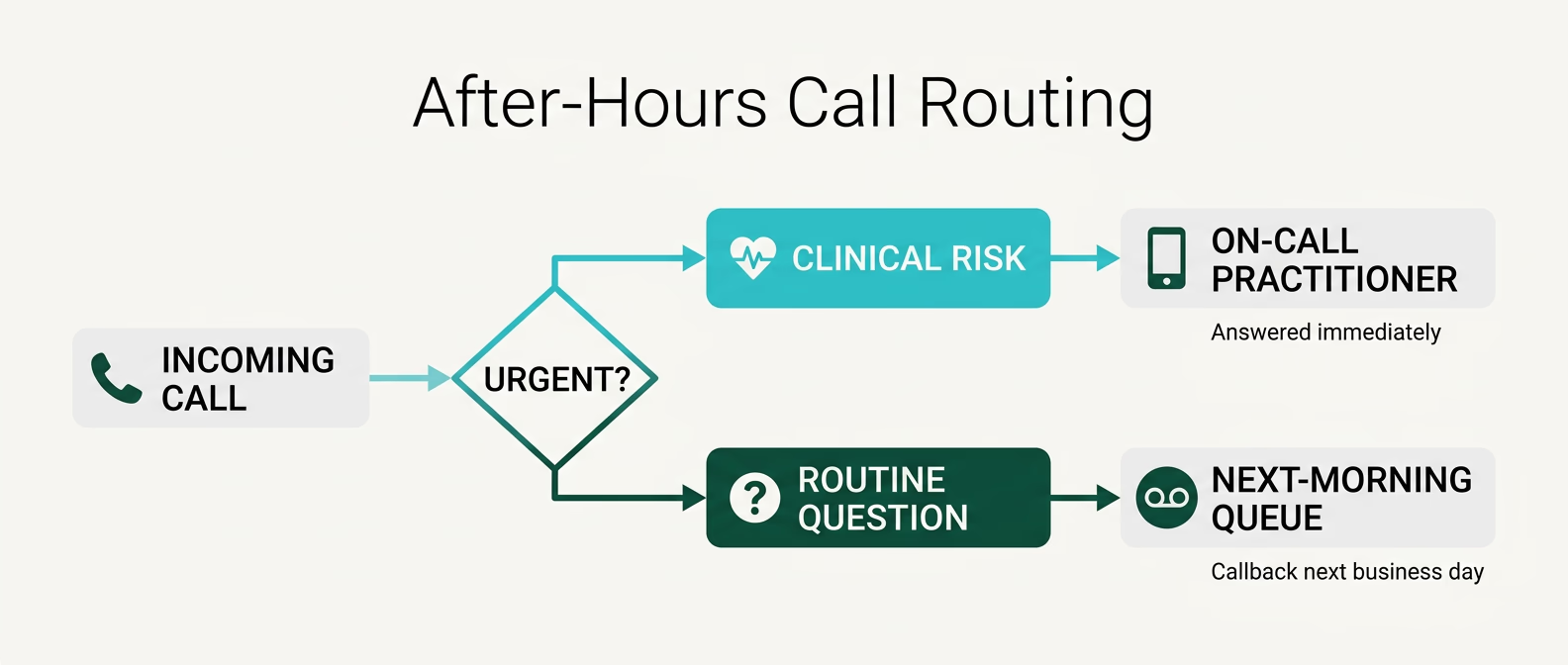
Not every after-hours call is the same. A patient asking “what were the results of my X-ray?” is a question. A callback the next morning is fine. But a patient saying “I have chest pain” is a risk. A 12-hour voicemail delay is a clinical event. So the after-hours routing needs to tell the difference. Risks go to the on-call immediately. Questions go to the next-morning callback queue. A blanket rule of “everything to voicemail” treats chest pain like an X-ray question. A blanket rule of “everything rings the on-call” burns the practitioner’s night on non-urgent calls.
The test is whether the after-hours setup can tell the two apart. SIPcity’s call routing can route by time of day. It can route by caller ID, for known patients versus unknown callers. It can also use a call tree option, such as “press one for clinical, press two for admin.” For a clinical-risk call, the system routes straight to the on-call practitioner’s mobile.
For a deeper look at how the AI voice agent fits a regulated practice, see our 2026 buyer’s guide for Australian regulated industries. It covers the data sovereignty, latency, and cost questions that matter for financial services, health, and government.
A good after-hours setup for an allied health clinic has three things. First, an Australian-hosted routing setup that does not send patient data offshore. Second, a defined multi-practitioner rotation with a defined fallback. So the on-call is clear, and the patient reaches a real practitioner, not a stranger. Third, a clinical-risk versus clinical-question split. So chest pain goes to the on-call immediately, and X-ray results go to next-morning voicemail. The Cloud PBX handles all three. It runs on month-to-month billing with no lock-in, because allied health practices want to keep their options open.
A bad after-hours setup has one or more of the opposite. An offshore call centre. A single number with no rotation. No way to tell risks from questions. Therefore a good after-hours phone coverage for allied health is the difference between two outcomes. Either a clinical-risk event reaches a real practitioner at seven p.m. Or it dies in a stranger’s voicemail queue. The Privacy Act 1988 and the allied health workflow both point to the same answer.
Allied health phone system is the cluster hub. The phone system for allied health practice guide covers the Privacy Act cross-border test. It also covers the multi-practitioner routing test. Cloud PBX for multi-practitioner clinics walks through the day-to-day working. The AI voice agent guide for Australian regulated industries covers the data sovereignty, latency, and cost questions for financial services, health, and government.
If you are setting up an allied health practice’s after-hours coverage, we are happy to help. We are also happy to fix one that is not working. We will walk you through what SIPcity’s after-hours call routing looks like in practice for a four-to-ten-practitioner clinic. We do not run a free trial. We run month-to-month billing with no lock-in, which is how we earn the right to keep your business. Talk to our team. We will pull a shortlist for your after-hours setup. We will do it in plain English, on a single 30-minute call.